
Left of the leftmost and right of the rightmost: where a rider is not expected
1 Nov 2026 · 8 min read
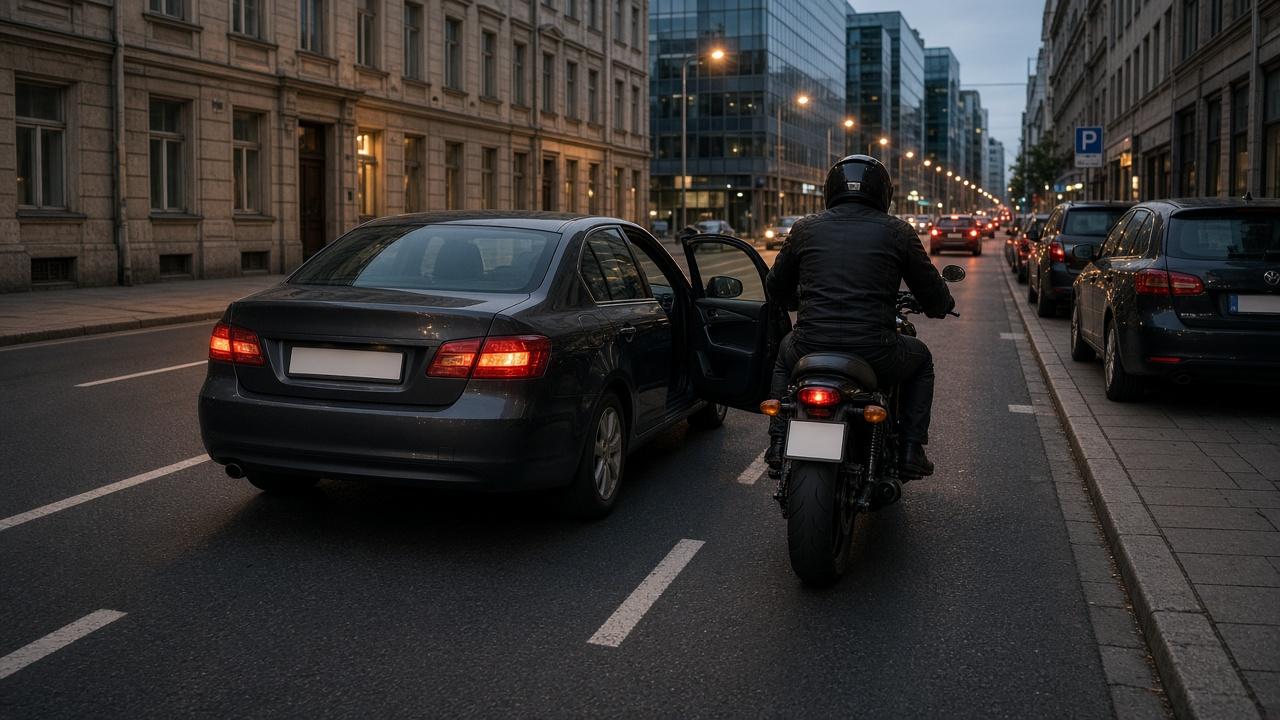
Riders have an old formula: do not ride left of the leftmost or right of the rightmost. It is about two dangerous places on the road. The first: you are to the left of the leftmost car in the stream, for example along the centre line, overtaking a line of traffic, or threading between oncoming lanes. The second: you are to the right of the rightmost car, pressed against the kerb, riding the shoulder, or passing the stream on the right.
In both cases you are where drivers barely look. Here is why each side is dangerous, what Estonia’s Traffic Act says, and how to choose a safe place in the lane.
Why it is dangerous to be left of the leftmost
A driver about to turn left or make a U-turn looks ahead at the oncoming lane and, at best, glances in the left mirror. A motorcycle overtaking on the left at that moment is easy to miss: it is narrow and closing fast.
The main dangers on the left:
- the car ahead starts a left turn into a yard, a filling station or a side road, straight across your path;
- a driver in the line decides to overtake and moves left without seeing you in the mirror;
- a car is coming the other way, and less than a metre is left between you;
- the mirrors of lorries and buses hang right at a rider’s head height;
- if you ride the centre line between oncoming lanes, you have no room to move, left or right.
The law says plainly that before a left turn a driver must move in good time to the left edge of their half of the road. So the space to the left of that car will soon be its path.
The Transport Administration’s 2025 report describes a fatal crash: at a junction an elderly driver turned left and pulled out in front of a motorcyclist.
What the law says about the left side
In Estonia you may overtake on the left. But before the overtake the driver must be sure that:
- nobody behind has already started to overtake them;
- the driver ahead in the same lane has not switched on the left indicator;
- the overtake creates no danger or hindrance for others;
- the lane they move into is clear for a sufficient distance;
- they can return to their lane without getting in anyone’s way.
If a danger appears during the overtake that could not have been foreseen, the overtake has to be broken off.
You may not overtake across the oncoming lane at a junction or close to one, except at junctions where drivers from the other directions must give way. Overtaking across the oncoming lane is also forbidden where visibility is limited, at a level crossing and before it, and at an unsignalised pedestrian crossing.
On a two-way road with three marked lanes you may not enter the far left lane: it is for oncoming traffic. If there are four lanes or more, riding on the oncoming half is forbidden. You pass an oncoming car on the right.
Why it is dangerous to be right of the rightmost
The right edge of the road collects everything that gets in a motorcycle’s way: sand, gravel, leaves, holes, manhole covers, drain grates. Braking and swerving on that surface is much harder.
The main dangers on the right:
- a car turns right into a yard or a car park and cuts across you;
- a door opens from a parked car;
- a pedestrian steps out from behind a stopped bus or between parked cars;
- a car pulls out of a yard or a car park and looks only left, at the main stream;
- a lorry or a bus has a large blind spot on the right, and in a right turn the rear swings towards the kerb;
- a bus at a stop may pull away and squeeze you against the edge.
Drivers are used to nobody being to their right in the stream. That is why many do not even look in the right mirror before a right turn.
What the law says about the right side and the shoulder
Overtaking on the right is allowed in one case: when the car ahead is turning left or making a U-turn and that is clearly visible. Then you overtake it on the right.
You may not overtake on the shoulder, on an acceleration or deceleration lane, or in a bus-stop bay. There is one exception: you may pass on the right a car that is turning left or making a U-turn.
On a motorcycle you may use the shoulder only in the cases the law lists separately. Those are stopping and parking, a turn that cannot be made otherwise because of a large radius or the state of the road, passing on the right a car that is turning left, meeting an oncoming car on a narrow road, and a slow vehicle moving to the edge to let a line of traffic pass. Ordinary riding along the shoulder past a jam is not on that list.
Separately, the law allows cyclists, riders of light personal vehicles, mini-mopeds and mopeds to pass stopped or slow cars on the right, if there is room and the car driver has not signalled a right turn. A motorcycle is not on that list.
There is a rule about doors too: a door may be opened only so that it does not create danger or a hindrance for others. But it is not worth counting on everyone keeping that rule.
What if you ride between the lanes
Riding between lanes of cars in a jam, called filtering or lane splitting, causes the most argument. Here is what the law says outright:
- on a road divided into lanes by markings, you must ride within a lane;
- a lane is meant for one line of cars, but two-wheeled motorcycles and mopeds may ride two abreast in it;
- passing a car without leaving your lane is called möödumine, and on your half of the road it is forbidden at an unsignalised pedestrian crossing, where visibility is limited and the lane markings cannot be seen, and beside a cyclist, a mini-moped or a light personal vehicle if you cannot keep a 1.5-metre side gap;
- on a road with two or more lanes in one direction, in dense traffic when every lane is equally full, you may not overtake the cars ahead;
- while moving you must keep a safe gap to the side.
Riding on the painted line between two lanes does not fit the requirement to stay within a lane. And the main point: even where the move is formally allowed, a driver in a jam is not expecting you. They may change lane, open a door or turn the wheel sharply to avoid a hole.
How to choose a safe place in the lane
The best place is where you can be seen and where there is space on both sides. A few practical rules:
- ride so you can see the face or the eyes of the driver ahead in their mirror: then they can see you too;
- do not linger beside a car, especially by its rear wing: that is a blind spot;
- approaching a junction, an exit or a car park, do not pass on the left or the right, slow down and watch the cars’ wheels;
- if the car ahead drifts towards the centre line and brakes, assume it will turn left, even with no indicator;
- if a car moves right and slows, do not go up the right: it may turn into a yard;
- beside parked cars stay further out, at least the width of an open door;
- in a jam keep a gap and leave yourself a way out, instead of squeezing into a slot between cars;
- out of town keep to the right side of the road, as the law requires, but do not hug the very edge, where there is sand and ruts.
The main point
The most dangerous place on the road is where nobody expects you. To the left of the stream you are missed by cars that turn and overtake. To the right you are missed by those who turn right, step out of a car or cross the road. Stay where you can be seen, leave yourself space, and always assume the driver next to you has not noticed you.
Id no. 90