
What kinds of motorcycle helmets there are, and how they differ
18 Oct 2026 · 5 min read
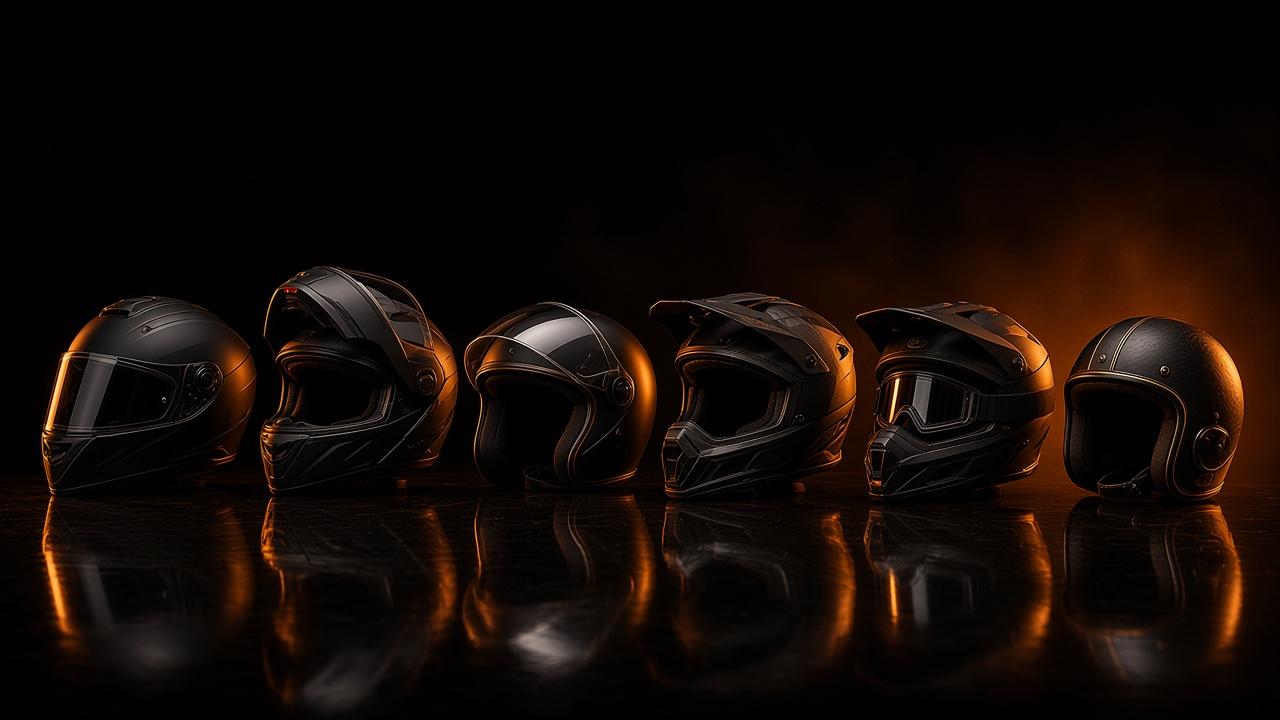
Full face
A closed helmet with a one-piece chin bar.
Who it is for: town, the highway, long trips and sport. It suits almost everyone.
Good points: the best protection for the face and the chin, quieter than the others, and the wind and grit stay out.
The drawbacks: it is harder to drink and to talk without taking the helmet off. In hot weather it is warmer.
Modular (flip-up)
A helmet with a front that flips up.
Who it is for: tourists and people who stop often.
Good points: you can open your face in a car park. The protection is close to a full face.
The drawbacks: heavier. The chin bar is fixed less firmly than on a one-piece helmet.
A flip-up marked P/J
This is a modular helmet tested in both positions: P means the chin bar is closed, J means it is open. If the helmet has no P/J mark, you must not ride with the chin bar open. Look for the mark on the label.
Open face (jet)
It covers the head, and the face is open.
Who it is for: scooters and a calm ride in town.
Good points: light, cheap, and it lets the air through.
The drawbacks: the face and the chin are not protected. It is noisy, and the wind and insects hit your face.
Open face with a visor
The same jet, but with a screen or a peak.
Good points: it shields the eyes from wind, rain and sun.
The drawbacks: the chin is still open.
Motocross (MX)
A long chin bar and a peak, with no visor. You need goggles.
Who it is for: motocross and dirt.
Good points: light, very well ventilated, and it works with goggles.
The drawbacks: noisy on the road, and at speed the peak pulls your head. Without a visor the face is open to rain and cold.
Enduro / adventure (dual sport)
Something between a motocross helmet and a full face: a peak, a wide view, and often a visor.
Who it is for: trips on tarmac and on dirt.
Good points: lighter than a full face, good ventilation, and you can take the visor off and put goggles on.
The drawbacks: noisier than a full face, and on the highway the peak pulls.
Half helmet and scrambler / retro
A half helmet covers only the top of the head. It is the weakest for protection, but it is light. Retro and scrambler helmets are usually an open face in a classic shape, sometimes with goggles.
Practical advice
Match the way you ride. In town, a jet or a modular. On the highway and on a tour, a full face or a P/J modular. On dirt, an MX or a dual sport.
The standard. Look for ECE 22.06, the newer and stricter one.
The size. Measure your head above the eyebrows. The helmet should sit tight, without pressing or rocking. Fasten the strap and turn your head: it should not shift.
The weight. A light helmet tires your neck less.
Noise. A closed full face blocks noise best. Earplugs help too.
Ventilation. Look for vents you can open and close. You need them in summer, and in winter you shut them.
Pinlock. This is an insert that stops the visor misting up. In Estonia, misting is a common problem in autumn and winter.
Winter and summer. In winter you want a helmet that covers the face and the neck well. In summer, ventilation and a light colour help.
Goggles and the helmet. Goggles go with an MX and a dual sport. Under a full face and a modular you usually do not need them, but check that yours fit.
Replacing it. Change the helmet about every 5 years, and straight after a hit. Do not buy a used helmet.
Id no. 27·…